30 September 2011
The Other Daughter in EC's Cinderella Issue
Hooray! My story, "The Other Daughter," along with the others in the Cinderella issue of Enchanted Conversation, is up today.
You won't believe how incredibly appropriate the artwork is to the story. It's perfect.
Labels:
Enchanted Conversation,
in print,
sweet success
28 August 2011
Upcoming Story in Enchanted Conversation
![]() |
| Edmund Dulac's Cinderella (Source) |
I just learned that my story "The Other Daughter" is going to be a part of the Cinderella issue of Enchanted Conversation. Couldn't be more excited.
22 August 2011
Exact Transcript of a Voice Mail Message I Received This Weekend
Yes, hello there, this message is for Gary. Your number was given to me by Natalie, regarding your boas and pythons and so on and so forth. My name is Joanne, and we were looking to meet and talk about the possibility of using one of your skates snakes for a couple of events. I am looking for an albino python if that's possible. My number is [redacted]. There is a cell phone number I'm going to call if that's okay, because this is a bit time-related and I'm excited to talk to you. Thanks so much.
My name is not Gary; I do not have an albino python. I hope Joanne found the albino python she desired when she called that cell phone number.
![]() |
| Source |
18 August 2011
Good and Evil
I recently came across this passage from Natalie Crohn Schmitt's essay, "The Idea of a Person in Medieval Morality Plays," published in a collection called The Drama in the Middle Ages (AMS, 1982). It offers a fascinating account of the Medieval European view of good and evil, and how this view influenced the way people experienced the world.
From "The Idea of a Person in Medieval Morality Plays" (quoted material is in italics:(
The war between Good and Evil was the profoundest reality of life, since upon the issue hung the eternal destiny of the soul. The salvation of the hard-pressed soul was the supreme prize of existence, and mortal life became subject to a single evaluation - the soul's progress toward God or its defection away from Him.
The adventure of life was, in our sense, inward and spiritual. God created the earth and the heavens and all things therein so that man might work out his life and destiny. Man was at the center of the universe and everything possessed significance not in itself but for man's pilgrimage.
The Devil and his demons indeed were very real and very close, and the powers of God and his angels needed constantly to be drawn upon to combat them.
What we call external reality was subordinate to the central conflict. The observer was himself in the picture at the center, and the world was more like a garment man wore about him than a stage on which he moved. The internal and external world were identified in a state of fusion and wholeness.
As a horror writer, I tend to think of evil as my bread and butter. Without some kind of badness, what would a horror plot be? For that matter, what would epic fantasy be without some Big Bad to confront and fight?
As a human being in this modern world of ours today, I have been led to believe that real life comes in shades of grey. It's fashionable to declare that there is no evil, only misunderstanding. (I don't think that's correct, for my two cents, but that's another blog post for another day.)
Reading this passage made me think a little harder about how different it might be to live in a culture that is totally immersed in the belief in concrete, tangible good and evil. Even if you're Christian, I don't know that it's possible to immerse yourself so totally into the mindset Schmitt describes here. You still have to contend with alternative points of view, even if you don't agree with them. In Medieval Europe, viewpoints that contradicted a Christian worldview were practically unthinkable, and where they were encountered, were dismissed as backward, which is to say, Satanic (thus folding them back into the good vs. evil point of view).
My question for you, Gentle Reader, is this: when you invent cultures with moral codes different from your own, how much do you alter the consciousness of your characters?
From "The Idea of a Person in Medieval Morality Plays" (quoted material is in italics:(
The war between Good and Evil was the profoundest reality of life, since upon the issue hung the eternal destiny of the soul. The salvation of the hard-pressed soul was the supreme prize of existence, and mortal life became subject to a single evaluation - the soul's progress toward God or its defection away from Him.
The adventure of life was, in our sense, inward and spiritual. God created the earth and the heavens and all things therein so that man might work out his life and destiny. Man was at the center of the universe and everything possessed significance not in itself but for man's pilgrimage.
The Devil and his demons indeed were very real and very close, and the powers of God and his angels needed constantly to be drawn upon to combat them.
What we call external reality was subordinate to the central conflict. The observer was himself in the picture at the center, and the world was more like a garment man wore about him than a stage on which he moved. The internal and external world were identified in a state of fusion and wholeness.
As a horror writer, I tend to think of evil as my bread and butter. Without some kind of badness, what would a horror plot be? For that matter, what would epic fantasy be without some Big Bad to confront and fight?
As a human being in this modern world of ours today, I have been led to believe that real life comes in shades of grey. It's fashionable to declare that there is no evil, only misunderstanding. (I don't think that's correct, for my two cents, but that's another blog post for another day.)
Reading this passage made me think a little harder about how different it might be to live in a culture that is totally immersed in the belief in concrete, tangible good and evil. Even if you're Christian, I don't know that it's possible to immerse yourself so totally into the mindset Schmitt describes here. You still have to contend with alternative points of view, even if you don't agree with them. In Medieval Europe, viewpoints that contradicted a Christian worldview were practically unthinkable, and where they were encountered, were dismissed as backward, which is to say, Satanic (thus folding them back into the good vs. evil point of view).
My question for you, Gentle Reader, is this: when you invent cultures with moral codes different from your own, how much do you alter the consciousness of your characters?
11 August 2011
Why I Write Horror Part 1: Dad
When I worked on my guest post, "Why I Write Horror," at Wicked & Tricksy a while back, I cheated. I wrote about one reason why I dig the dark stuff, but in fact there's a whole grab bag of tidbits from my personal history that contributed to making me the horror writer I am today. Here's one.
My dad is a great storyteller. Although he was a construction inspector by trade before he retired, his real gift lies in converting the daring exploits and bizarre interludes of his youth into sheer entertainment. On a regular basis when we were growing up, Dad would have me and my brother howling with laughter until we couldn't breathe and we thought we would expire.
In terms of sheer craft, I admire Dad immensely. He has a knack for building intrigue and using detail to peak interest as effectively as any seasoned novelist. I aspire to be able to set 'em up and knock 'em down as well as my dad.
But the real value in growing up hearing his stories for me lay in the persistent (or I should maybe say, pernicious) thread that ran through all of his tales. Everywhere in his stories are hints of threat, glimpses of the edge of reason or the neat boundary described by the law.
There's the casual violence: a story about a math teacher who banged a kid's head against the chalk board for talking in class. The high school gym instructor who dealt with insolent students by making them put on the gloves and go a couple of rounds in the ring with him.
There's the adult stuff. For a while, dad's family lived with his grandfather, my great-grandfather. Great-granddad was, by all accounts, an interesting fellow. He sold booze out of his home at a time when it was only available if you bought it from a bar. For hardcore alcoholics, this was a difficult time, since you couldn't get rid of your morning shakes until the bars opened later in the day.
When my dad was still a schoolkid and all this was going on, his bedroom was at the front of the house on the ground floor. Some mornings, the local butcher would come and knock on the window to wake my dad up. Dad would go to the kitchen, pour the guy his morning drink, take his money, and fix himself a bowl of cereal. While Dad ate his cornflakes, the butcher would talk to him about history.
"He really knew a lot," Dad always says.
And then there are the stories about the fighting cocks. Great-granddad raised them. Dad has a lot of stories about these animals: about Great-granddad tossing a rooster in the air repeatedly to exercise him and strengthen his legs so he would be strong in a fight. About the razor-sharp steel spikes the owners would attach to the roosters' legs that would turn any match into a fight to the death. "Saturday night's loser was Sunday night's dinner," Dad says. Dad tells a great story about driving with his dad and granddad over the border into the U.S. on their way down to Buffalo for a fight. "It was my job to keep the roosters quiet in the back seat of the car when we crossed the border," Dad tells us. "You had to keep the cover over them and not let in any light, or they would start making noise."
For me, raised in a small town where nothing untoward ever seemed to happen, Dad's stories spoke to a wider reality, where almost anything was possible, and life served up equal helpings of badness and wonder. Dad is one reason why I write horror.
![]() |
| Source |
In terms of sheer craft, I admire Dad immensely. He has a knack for building intrigue and using detail to peak interest as effectively as any seasoned novelist. I aspire to be able to set 'em up and knock 'em down as well as my dad.
But the real value in growing up hearing his stories for me lay in the persistent (or I should maybe say, pernicious) thread that ran through all of his tales. Everywhere in his stories are hints of threat, glimpses of the edge of reason or the neat boundary described by the law.
There's the casual violence: a story about a math teacher who banged a kid's head against the chalk board for talking in class. The high school gym instructor who dealt with insolent students by making them put on the gloves and go a couple of rounds in the ring with him.
There's the adult stuff. For a while, dad's family lived with his grandfather, my great-grandfather. Great-granddad was, by all accounts, an interesting fellow. He sold booze out of his home at a time when it was only available if you bought it from a bar. For hardcore alcoholics, this was a difficult time, since you couldn't get rid of your morning shakes until the bars opened later in the day.
When my dad was still a schoolkid and all this was going on, his bedroom was at the front of the house on the ground floor. Some mornings, the local butcher would come and knock on the window to wake my dad up. Dad would go to the kitchen, pour the guy his morning drink, take his money, and fix himself a bowl of cereal. While Dad ate his cornflakes, the butcher would talk to him about history.
"He really knew a lot," Dad always says.
And then there are the stories about the fighting cocks. Great-granddad raised them. Dad has a lot of stories about these animals: about Great-granddad tossing a rooster in the air repeatedly to exercise him and strengthen his legs so he would be strong in a fight. About the razor-sharp steel spikes the owners would attach to the roosters' legs that would turn any match into a fight to the death. "Saturday night's loser was Sunday night's dinner," Dad says. Dad tells a great story about driving with his dad and granddad over the border into the U.S. on their way down to Buffalo for a fight. "It was my job to keep the roosters quiet in the back seat of the car when we crossed the border," Dad tells us. "You had to keep the cover over them and not let in any light, or they would start making noise."
For me, raised in a small town where nothing untoward ever seemed to happen, Dad's stories spoke to a wider reality, where almost anything was possible, and life served up equal helpings of badness and wonder. Dad is one reason why I write horror.
25 July 2011
Book Giveaway for Grad Students
This is not so much a draw or a contest as an offer to pass on genuinely helpful books to someone who can use them. As I've mentioned before, I attended grad school and earned a PhD. in English Literature, with a specialization in Renaissance drama and a twist of medical history. I have a handful of books from that time that I can no longer use, but which are good and helpful.
If you are a grad student, and especially if you are a doctoral candidate in the arts or social sciences, and you would like these books, I will mail them to you. Not to frown upon science majors, but these books are skewed toward the arts / social sciences side of campus, where publishing a book when you're fresh out of grad school is de rigueur these days. I will mail them anywhere in the US or Canada.
Just drop me a line in the comments on this post and include an email address that I can use to contact you. This is a first come, first served situation. I do ask that you be in grad school and planning to complete a PhD in the arts or social sciences.
Joan Bolker, Writing Your Dissertation in Fifteen Minutes a Day
This is the single most helpful how-to-write-a-thesis book I encountered during grad school. My copy is unmarked but a little wrinkly because I read it multiple times and possibly put it on a shelf under a leaky houseplant for a while. It saved me a lot of headaches as I worked out how to do the dissertation.
William Germano's From Dissertation to Book

Let's say you get your thesis finished and you defend it successfully and you've got your shiny PhD in hand. This book is aimed at helping you convert that project into a publishable book. My copy is in good shape with scanty highlighting throughout. In today's academic environment, where you are expected to emerge from the womb clutching your already-published book, it might help you to keep in mind the dissertation / book relationship throughout the writing process - save a little time, you know?
William Germano's Getting It Published

My copy is the first edition, not the second edition pictured here. It is fairly pristine, and is about publishing your serious book once you've finished converting the thesis into a book.
Various Authors, The Thesis and the Book

Along the same lines as From Dissertation to Book, this is a collection of essays about common pitfalls and solutions as you work toward publishing your first academic volume. My copy is fairly pristine.
If you are a grad student, and especially if you are a doctoral candidate in the arts or social sciences, and you would like these books, I will mail them to you. Not to frown upon science majors, but these books are skewed toward the arts / social sciences side of campus, where publishing a book when you're fresh out of grad school is de rigueur these days. I will mail them anywhere in the US or Canada.
Just drop me a line in the comments on this post and include an email address that I can use to contact you. This is a first come, first served situation. I do ask that you be in grad school and planning to complete a PhD in the arts or social sciences.
This is the single most helpful how-to-write-a-thesis book I encountered during grad school. My copy is unmarked but a little wrinkly because I read it multiple times and possibly put it on a shelf under a leaky houseplant for a while. It saved me a lot of headaches as I worked out how to do the dissertation.
Let's say you get your thesis finished and you defend it successfully and you've got your shiny PhD in hand. This book is aimed at helping you convert that project into a publishable book. My copy is in good shape with scanty highlighting throughout. In today's academic environment, where you are expected to emerge from the womb clutching your already-published book, it might help you to keep in mind the dissertation / book relationship throughout the writing process - save a little time, you know?
My copy is the first edition, not the second edition pictured here. It is fairly pristine, and is about publishing your serious book once you've finished converting the thesis into a book.
Along the same lines as From Dissertation to Book, this is a collection of essays about common pitfalls and solutions as you work toward publishing your first academic volume. My copy is fairly pristine.
22 July 2011
My Guest Post at Wicked & Tricksy
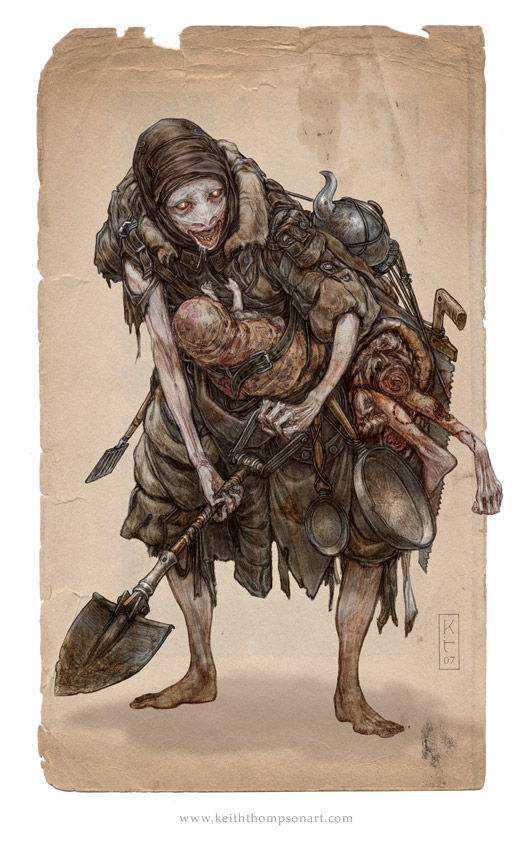
Over at Wicked & Tricksy today I've got a post up called Why I Write Horror. Really it's about my earliest defining encounter with a [literary] ghoul who just wouldn't leave me alone. Go check it out. While you're there, poke around W&T if you haven't had the chance to yet. There are many fine and enlightening essays up about writing speculative fiction. It's good stuff.
Writing that post inspired a trip down memory lane. I plan to post more about my early encounters with horror over the next month or so.
![]() |
| Source: the deliciously gruesome Keith Thompson |
Subscribe to:
Comments (Atom)