Pages

Showing posts with label filling the well. Show all posts

23 March 2011

Haunted Hamilton, Ghostly Encounters, and the Anatomy of Scary Scenes

On Saturday evening, the night of the supermoon, Dave and I took a tour of the Customs House here in Hamilton, courtesy of a group called Haunted Hamilton. This building, built in 1858, first housed the federal centre controlling the flow of trade through our town. Now the building houses the Workers Arts and Heritage Centre, and I suppose you could go in there during the daytime to take a look at the building and the labour-related artwork that hangs in the galleries, but I suspect the only way to see the creepy third attic level and the weird little rooms in the basement is to go with a ghost tour.

I am a fan of local architecture and of old buildings in general, of which Hamilton has oodles. I couldn't resist the chance to traipse through the Customs House guided by someone in period costume who had lots of spooky stories to share.

There's a third story in this building that you can't see from the outside...spooky.

I have written before about my love of the paranormal and how I am really, really susceptible to anything scary, which is why I love horror as a genre. For me, a good scary story or spooky experience is as good as skydiving or climbing Mount Everest. I studied theatre and drama extensively in school, so any live performance or live storytelling is fun for me.

I loved this ghost walk because it wrapped all of these elements up in black silk with a big, shiny bow on top.  In the gallery, our guide, Lady Elizabeth, and her fellow ghost guides talked about the history of the building, its onetime status as a macaroni factory, as a school, as an abandoned, decrepit ruin, and its refurbishment as a martial arts studio. The story of the building underwrote all the other tales we heard that night.

The guides all talked about watching the large metal latches on the windows in the gallery swing of their own accord. Lady Elizabeth talked about people hearing the footsteps and laughter of children in the second floor hallway, of gruesome murders and dark deeds performed in and around the Customs House, and also of accidental deaths.

In one room, as we clustered around the dim light of Lady Elizabeth's kerosene lantern, I felt a light but persistent touch on my right leg just at my knee. The energies of the House shifted from downright oppressive in the main gallery to rich with history in the attic to almost explosive in the basement, especially in the one room with the creepy staircase that now goes nowhere, cut off in a renovation. The weight of history weighs heavy in the vault, the location of the burial of the Dark Lady, the Customs House's most famous ghost, and also the accidental burial of fifteen men, hobos who died in a cave-in as they tried to warm themselves in the tunnel that once led from the harbour to the house.

I was shit scared the entire time. It was awesome. So I'm writing this post with a double agenda: one, I want each and every one of you reading this to come visit Hamilton so I can take you on this ghost tour. Seriously, it will be a blast.

Two, I have been thinking about how to capture the spooky essence of ghost stories in fiction.

The thing about ghost stories is that they are basically just fragments of experience. All they tell you is that something weird happened to someone. The main character is always "a woman" or "a man." If you're lucky, you might get to hear the experiencer tell his or her own story, but you don't need to know anything specific about him or her to be scared, because the story is really about everyman / everywoman - i.e. you or someone like you. The context of the story is always "this really happened," even if the account has become fictionalized over time. The idea that regular reality could go suddenly off-kilter is, I think, why these tales are scary.


My question is, how can we get the same spook effect in our fiction? I find that a lot of horror produces gross-outs and takes me outside of the terms of polite society quite reliably (it's hard to teach zombies table manners), but it's a rare book that really haunts me, in the sense that it makes me feel scared to walk down the dark hallway between my bedroom and the bathroom in the middle of the night.

I remember some passages in Stephen King's It that did the trick. It's been a million years since I've read it, and I think I borrowed a library copy, so I don't have it on hand, but there was a scene where one of the kids (or more?) was looking through a photo album and one of the pictures changed. I think Pennywise, the evil clown antagonist showed up in the photo? Or something? (I know...it doesn't sound that scary, but believe me, it was!) Much more strongly than the scene itself, I remember where I was when I read it: it was a summer during high school. I had stayed up super late to read. As events unfolded in the scene, I felt the world around me turning inside out. Even though I was sitting comfortably in my room in the warm glow of my cosy reading lamp, I remember feeling paralyzed, like I couldn't and shouldn't move, and I remember wishing that my bedroom window wasn't open - I suddenly felt totally vulnerable. I most definitely wished I hadn't chosen to stay up reading that book.

That was twenty-five years ago, probably. That's a long time to remember something so vividly. That's powerful stuff. I want to have that kind of effect on people, don't you?

There are some ways that a scene like that resembles the spine-chilling ghost stories told at the Customs House. King is great at building characters that are generic, everyman / everywoman sorts of people (without being boring - that's the real trick). Even if you don't feel a strong connection with that specific character, in a good scary scene, the character is often doing something totally normal that you have probably done, like looking through a photo album. The sudden swerve of reality into unfamiliar, potentially threatening territory is what creates, I think, the most powerful spook factor. Leaving aside the gah! clown! factor and the specific trappings of that scene from It, I'm thinking that maybe this is a workable formula: 1) establish a strong sense of normal, plain, everyday reality and 2) take the character out of that reality into somewhere else that has negative implications for his / her safety and wellbeing.

Maybe this is a good place to start. I'd love it if you all would share your scary stories / favourite scary moments from fiction. What do you think is scary? More importantly, why do you think it scares you?

12 March 2011

The Century of the Self

When Dave and I were negotiating how we would live together four years ago, he told me he didn't want to get cable TV. I was already spending much of my time watching television via DVD, so I had no problem with this. Today, any time I find myself sitting in front of a conventional television, I am blown away by how many and how disruptive the commercials are. Seriously, I used to sit through all that? Yikes!

I've been in the habit of heading out to our local library branch to borrow DVDs, and Dave has hooked up a computer with internet connection to my old TV, so we're never short on things to watch. Lately, we've been into documentaries, and are huge fans of much of what the BBC has to offer.

Enter The Century of the Self. If you're a Mad Men fan, you might be interested in this. Starting with Freud's development of his theory of the self in the early 20th century, it talks about how corporate and political forces have used these theories to shape and manipulate public consciousness. If you're interested in dystopian fiction, you might be interested in the ways public policy makers throughout the 20th century sought to control what they perceived as a society constantly on the verge of mass revolt and violence.

This set of four one-hour programs really gets to the heart of how we see ourselves, and how the powers that be deliberately shaped this self-perception in order to achieve specific ends. It's no coincidence that in the course of 100 years, we've gone from being consumers of necessities to consumers of any number of delights. It's no coincidence that one of the number one values of our culture is "individuality," while more and more we police each other in the name of conformity.

This is a chilling story, and one worth knowing about. I think The Century of the Self is essential viewing for anyone interested in why we are the way we are - a great set of insights for anyone who wants to understand the mechanics of world building or the way that large social movements get started and persist.

From the introduction:

A new theory about human nature was put forward by Sigmund Freud. He had discovered, he said, primitive sexual and aggressive forces, hidden deep inside the minds of all human beings - forces which if not controlled, led individuals and societies to chaos and destruction. This series is about how those in power used Freud's theories to try to control the dangerous crowd in an age of mass democracy. 

13 February 2011

What Write 1 Sub 1 Is Doing for Me

Yippee! Skippee!
I joined the Write 1, Sub 1 Challenge sometime in mid-January, let's say sometime in the middle of week 3. It's now the end of week 6, and I wanted to share some thoughts about how doing the challenge has helped me.

Goal-setting is relatively ineffective for me. I tend to reach somewhere between 50 and 70 percent of any writing goal I set for myself. But joining a challenge and having some kind of external-to-me group to whom I can report? Much better. For example, this week I had a couple of different short story ideas, but both of them required research and were probably going to be longer pieces. I didn't do any writing on either of them, but I got some novel writing done while I was procrastinating, and I did think about them a whole lot. In an effort to get something submitted this week, I went back and edited a short story that's been sitting on my hard drive since October. And this afternoon, I decided I just couldn't let a week go by without at least making an attempt to produce a new short story. I drafted half of one today.

It was a productive week, in other words. Even if I didn't meet the challenge this week, I'll have a couple of pieces that will probably be ready to go for a first round of submissions by the end of next week.

And this is my main point: Write 1 Sub 1 has gotten my creaky submission process in gear. I will sometimes go through jags of submitting stuff, only to drift away from it later. But the idea of having to get a story in fighting shape, super fast, is helping me to see that doing so doesn't have to be a laborious, painstaking process. It can be a fun, roller coaster, extra super fast laborious and painstaking process.

For the first time in a while, I'm engaging a skill I learned in grad school: researching, composing and editing a piece of writing at high speed and with an eye to high quality. I know I can do this. And hey, there will be time for any further necessary revisions after the rejections roll in, right?

A bit of theory here: in The Artist's Way, Julia Cameron uses the metaphor of "filling the well" to argue that what we really need as artists is a source of images, experiences, or encounters with art in order to stimulate our process. Otherwise, we risk becoming drained or "empty."

Right now, I'm feeling like a different metaphor is appropriate. I'm finding that as I work to "empty the well" by using ideas and engaging in writing, editing, polishing and submitting, I'm giving room for more fresh inspiration to flow in. Instead of stale, stagnant waters, I've got fresh, spring-fed, bubbling coolness. There might even be the odd mysterious sea creature down there.

I'm looking forward to finding out.

02 January 2011

Movies as Folk Art

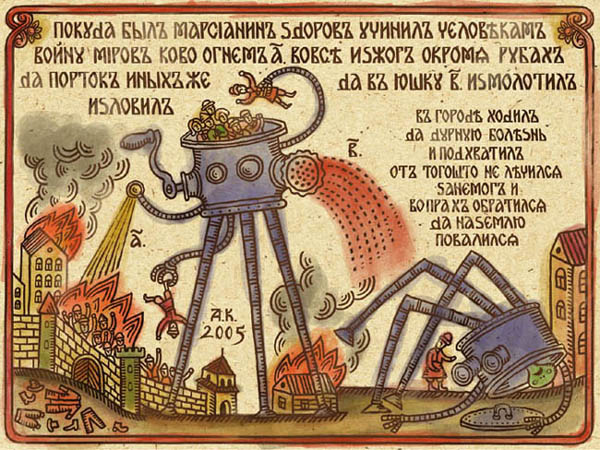
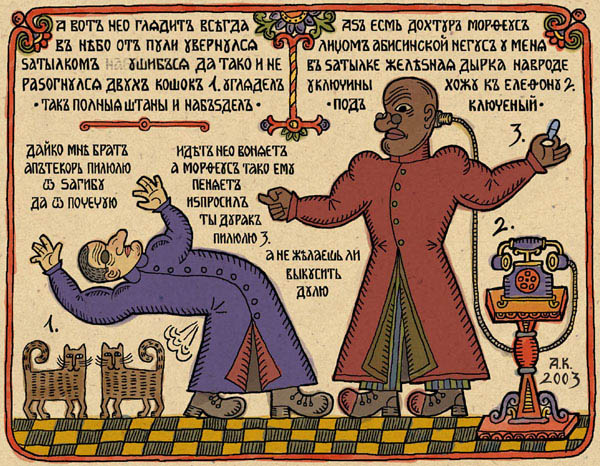
Are you familiar with lubok? This Russian folk art form involves simple artwork and narratives taken from popular and classic literature, made up into poster-like art that you can hang on the wall, like this one from the late 18th century, "The Mice Are Burying the Cat."


Russian artist Andrey Kuznetsov used science fiction and fantasy films to create amazing lubok art. These are really delightful. I only wish I knew what the text said. Anybody?

Enjoy. More here.


ShareThis